Cromblog
Simulating Civilizations III
June 30, 2026 · 12 min read
Returning to the custom Azhora map from the last post, I decided this run to integrate the Clashvergence and World Builder projects, making the latter more like the setting. The climate layer now uses the Koppen classification system. Each hex can carry a more specific climate than before. A wide range of climates from humid subtropical shores, oceanic coasts, steppe interiors, highlands, tundra, and desert margins all shape the continent of Azhora at the same time. The World Builder map now exports into the simulation format, and it carries a prebuilt Azhora lore corpus plus a map-linked lore file so regions, climates, languages, and authored geography can all travel with the simulation rather than being pasted in afterward, though they may be tampering with the organic development of the history.
In the first, the premise is simple: one people, one map, and 150 years of splintering. The parameters in this post are for feeling out how the system behaves. They should not be read as a careful assessment of ideal comparison settings.
First: One Founding People
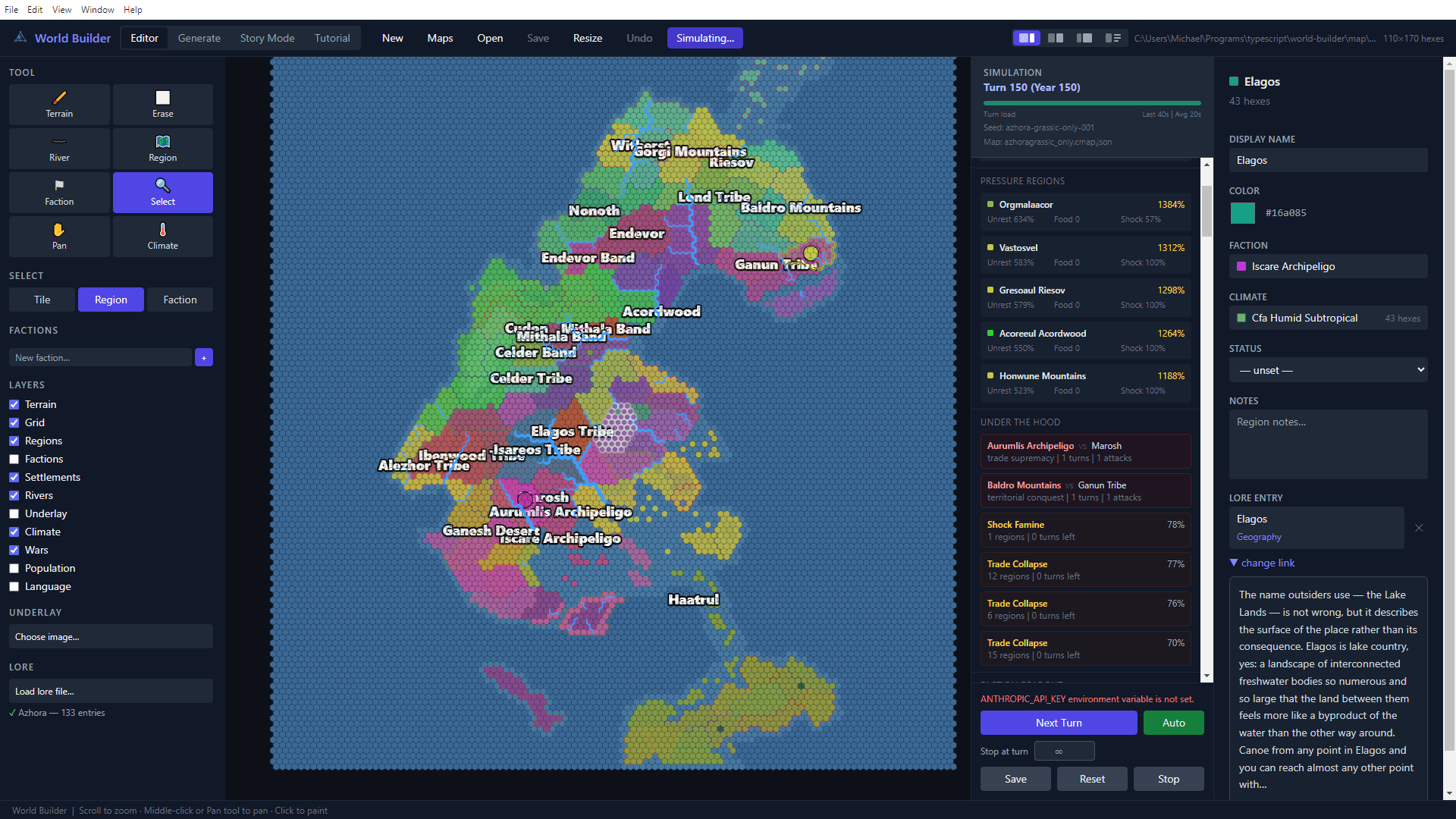
The first scenario uses the same Azhora map and climate layer, but only one founding people is present at the beginning and no new peoples arrive from outside the map. By turn 150, the result is already recognizably historical rather than blankly procedural. It is not calmer than the larger run, but its violence has a different flavor: almost every later polity is a descendant, rebel branch, or renamed daughter house of the original founding people.
The Narrative Layer
I also reworked the narrative generator. Earlier versions could read the simulation results, but they still sounded too much like out of touch analysts summarizing game state. They would say, plainly, how much money a polity had or how many regions it held. That is useful evidence for the engine, but it is not how a person in Azhora would talk about a troubled realm, and the goal is believability within the scope of this world.
The new version uses retrieval-augmented generation. Before the final chronicle is written, the generator pulls style passages from a small corpus. Right now it includes Herodotus and Lord Dunsany, combining their influence into an idiosyncratically structured summary of the simulation. It also now builds story seeds from raw outcomes: weak treasuries lead to unpaid garrisons, low storehouses, and toll roads costing more than they return.
Generated Historical ChronicleThe Single-Civilization ChronicleTurn 150, one founding people, no staged arrivalsOpen chronicle
The Beluvethrite Calendar opens not with a throne but with a camp in East Mithala. For a few years even that certainty wanders. Grassic feet move from East Mithala to South Mithala, back again, then toward West Mithala and Henborth, as if the people were learning the shape of Azhora by wearing paths into it. The first Grassic memory of the age is therefore not conquest, but choosing and unchoosing home.
By Year 24, Grassic Kin Tribe had claimed Henborth, and the single seed began to show the strange abundance of a breaking branch. The map did not remain unified merely because all later houses shared an origin. It became more intimate, and therefore more bitter. Isareos, Lond, Mithala, Qadwaaqaad, Marosh, Endevor, Ibenwood, Riesov, Acor Wetlands, and Haatrul were descendants, camp followers, rebel courts, and daughter names trying to become ancestors of their own.
The early fractures came quickly. In Year 48, Konwoaul Archipeligo broke away from Henborth Wayfarer Band and began the Iscare Archipeligo rising. In Year 51, Marosh broke from Celder Trail Band. In Year 52, West Endevor broke from Narcosh Band. The annals make these sound like clean entries, but one should imagine messier scenes: household gods carried from old camps into new halls, young warriors repainting shields before their fathers had stopped calling them disobedient, elders arguing whether a new seal could still be called Grassic.
This is the grain of the age: pressure is genealogical. The Grassic Kin Tribe could compel Isareos Tribe into tribute in Year 66, but such obedience was already a family wound. Tribute wagons did not arrive from strangers. They came from a daughter people, with sealed oaths that must have sounded half like submission and half like accusation.
Religion changed for the same reason. Ibenwood, born from Southlass and then reaching toward West Ibenwood, searched for rites that could make its separation lawful: Korukoan in Year 77, Gaulogeulan in Year 83, Aulbengeilan in Year 89, Sorbenetheran in Year 95, and Eulbenekean in Year 101. The important thing is not the list of names but the work behind them. Priests in Southlass were not decorating a finished state. They were trying to teach people why the old obedience had ended without making the old dead into enemies.
Acor Wetlands repeated that sacred labor in its own marsh and river country, raising Belonulan in Year 93, Humonolan in Year 99, and Golinulan in Year 105. Such reforms feel less like theological curiosity than repair work after political rupture. A new realm needs roads, storehouses, and guards, but it also needs a way for children to ask whose ancestors hear them. The lesson is unusually plain: nearly every altar is a rearrangement of the same inherited language of legitimacy.
The middle and late years were wars of corridors and crossings. Riesov captured Goodko Mountains from Central Thoth in Year 115, and Central Thoth captured Nothwoodis from Nothwood in Year 123. Ibenwood took Beneigaul Archipeligo from Haatrul in Year 128. These were contests for movement as much as possession. At the fortified crossings, men would have seen old cousins as enemies, and at the harbors merchants would have learned that a familiar tongue does not make a toll easier to pay.
Haatrul became the sharpest late example. The Haatrul rising, itself sprung from Narcosh Wind Band, claimed Barqat in Year 100 and then inherited the anger that follows ambitious rule. By Year 139, and again in Years 145 and 149, Haatrul and Qadwaaqaad Tribe had hardened into rivalry. In Year 150, Haatrul and the Iscare Archipeligo rising did the same. One may picture envoys kept waiting beside unopened seals, not because no one knew the formulas, but because everyone knew them too well and had learned how to insult them precisely.
So the first 150 years do not yield a simple origin myth. They yield an inward history, one in which a single founding people becomes so many houses that the old name can no longer command them. Azhora is already full of war, tribute, reform, and overextended roads, but the emotional weather is inheritance: family quarrel made territorial, old obedience broken into new courts, and descendants learning to pronounce themselves as founders.
Then: Staged Arrivals
In this larger example here I change the premise. Instead of one ancestral people generating almost every later faction by descent, eight founding civilizations enter Azhora over the first 400 turns. That gives the engine several unrelated centers of memory, language, religion, and ambition, so the generated chronicle has to explain both internal fragmentation and collisions between peoples who do not share the same starting story.
This run is larger and messier by design. It is influenced by the push I have based on a vision I have long had for how the history of this fictional continent would take shape, meaning these settings are exploratory rather than carefully optimized. The attention is also to narrative quality, particularly believability.
For this run I gave the narrator a position inside the world. He is an East Lond chronicler of Boueni descent, writing among surviving Riesov speakers whose language still belongs to the Boueni family. That changes the shape of the account, opening it with the arrival, loss, inherited grievance, and the uneasy knowledge that a homeland may survive without the people who first named it.
| Turn | Civilization | Arrival | Pressure |
|---|---|---|---|
| 0 | Boueni | North Riesov | Industrious, population growth |
| 20 | Moreshi | Marosh | Commercial, population growth |
| 120 | Grassic | East Mithala | Territorial, population growth |
| 150 | Pyrosi | West Pyros | Militarist, conquering |
| 250 | Mittoli | East Mithala | Territorial, conquering |
| 270 | Ibenal | South Acordwood | Industrious, isolationist |
| 370 | Telemoni | Telemonia | Militarist, isolationist |
| 400 | Tennoca | Cape Thalmagar | Commercial, defensive |
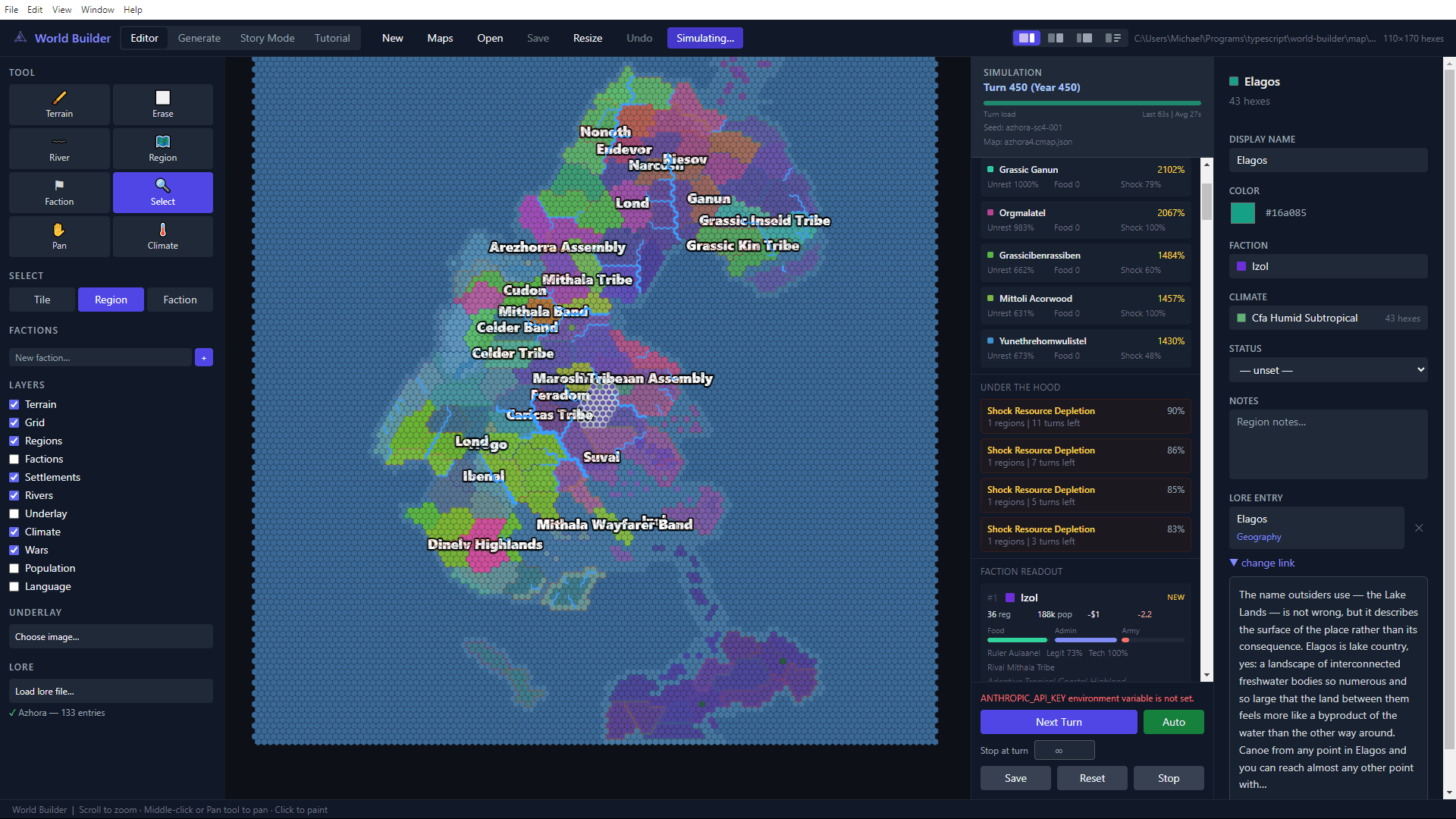
Generated Historical ChronicleThe Boueni-Descended ChronicleTurn 450, staged arrivals, Boueni-remnant narratorOpen chronicle
I write in East Lond, where the speech of the market is Riesov now, but where an attentive ear still hears Boueni roots beneath the later endings. We are not the first Boueni, and it would be vanity to pretend that we are. We are their remainder, their daughter speech, their argument with defeat. The old people here say that a homeland can be lost in three ways: first by road, when tribute goes elsewhere; then by altar, when another line names the dead; and last by tongue, when children no longer know why a valley has its name. By that harsh measure the Boueni have not wholly vanished. We have lost much, but in East Lond the old stems still live in prayers, oaths, insults, and lullabies.
The annals give us no clean landing day for the Boueni. They show our people already present at the opening of the Grassic Annals, with House Srelaem remembered in the first standing and Mesuonrite rites binding hearth to burial ground. The family songs make Geueenalta Riesov the first center, the country where fires were banked against the cold and the names of ridges were fixed by use before they were fixed by scribes. Yet the same records also remember wandering. In Year 3 the Boueni Band moved camp from West Baldro Mountains into East Lond. I have always found that entry hard to pass over. Here, where I write, was not merely a later refuge of our daughter people; it was one of the early places where Boueni feet tested whether a camp could become a home.
Then came Year 11, the wound from which all Boueni history after the beginning must speak. Geueenalta Riesov broke away from Boueni Band, and the Riesov rising began. The homeland kept its old sacred weight but no longer obeyed the old band. Those who stood there were of our stock and kept Mesuonrite forms, yet they became something other than Boueni in the narrow sense. The annals call them Riesov, and so do I, for a chronicler must not steal names back from the dead or the living. But every Riesov child who can hear the Boueni roots in a place-name knows that secession was also inheritance. A branch tore itself free and became a trunk; those left behind learned that a people may survive first by losing its own descendants.
The Boueni Band itself soon ceased to matter as a power. That is not the same as saying it ceased to matter. Some houses build long dominion; others scatter the seeds from which later houses quarrel. From the Boueni rupture one may understand the whole Age of Houses and Altars. The Grassic Kin Tribe, rooted in East Mithala, sent out Celder, Henborth, Mithala bands, and through them many further realms. The Mithala offshoots in turn gave rise to Ganun, Izol, Cudon, Feradom, Narcosh, Nonoth, Ibenal, and others. The world was not conquered by a single hand. It split and resettled itself by bloodline, rite, debt, and road. Every new polity spoke as if it had always been separate; every old polity remembered the moment before separation.
The first great lesson beyond our own loss came from Marosh. For many years the Marosh Tribe seemed to possess the steadiness the Boueni lacked: orderly successions under Line Baraaat in Years 43, 62, 86, 97, 123, and 140, each ruler raised before elders who knew how to make continuity look inevitable. But the marches heard weakness before the court admitted it. In Year 138 the Grasako Highlands broke away, beginning the Dinelv Highlands rising. In Year 144 Dinelv claimed East Ibenwood, a frontier gateway whose tolls and crossings were worth more than its stones. Then Marosh suffered a succession crisis under Barias in Year 151, lost Hamabel to the Hama rising in Year 153, and saw Amodthothdorhom break away in Year 172 under the Moleaaan Assembly claimant. A realm is not hollowed only by enemies. It is hollowed when roads begin to answer to other seals.
A caravan-master once described to me a pass above East Ibenwood where an old Marosh stone had been recut by Dinelv hands. The earlier mark showed through in winter light, he said, because the new carving was shallow and hurried. I cannot prove the stone, but the story is true in its shape. The Dinelv rising did not merely take country; it changed whose oath protected shepherds, whose men collected crossing dues, and whose priests blessed the boundary stones. That is how an upland becomes a state: not by the first spear, but by the second season, when ordinary people discover which name keeps them from being plundered.
The struggle over the Grasako country sharpened in Year 190, when the Ibenal rising captured Grasako Highlands from Dinelv in a war for trade supremacy. Ibenal had already taken South Ibenwood in Year 175, and so its lords were joining wood, slope, and crossing into a corridor of ambition. The reports speak of blockade and naval force, which may seem strange for highland war until one remembers that every pass has a harbor somewhere behind it. A western mariner told of mountain men buying pitch, rope, and iron nails as if fitting ships. Whether they meant to master harbors or merely starve them, the lesson was the same: in this age even a ridge could be conquered by controlling the water beyond it.
Our own Riesov memory suffered a second bitterness in Year 197, when the Nonoth rising captured Gulawuudlen Thoth from the Riesov rising in a war of subjugation. Gulawuudlen Thoth was a crossing-place, a throat of tolls, timber, provisions, and river movement. To lose it was not simply to lose ground. It was to hear foreign tallies read where one's own elders had once counted dues. The Nonoth came from the Mithala Wind Band, but after the conquest they too had to answer the old question of obedience. Much later, in Year 302, they broke from Homakean and raised Gulenean. I read that reform as the language of conquerors who had learned that force alone cannot make a conquered crossing loyal. A garrison can hold a quay; it cannot make the quay's memories kneel.
The broadest ambition belonged to Izol. Born from Mithala Reed Band, under Line Golavothcad and Korutherrite rites, Izol claimed Qadwaaqaad in Year 203. The annals call it pivotal, and here the dry word is right. Qadwaaqaad opened a frontier gate through which watchposts, survey markers, levies, and tax men could pass. One merchant tale says that a scribe there kept two sets of tablets after the Izol claim: one for older obligations, one for the new demands. For a season both were collected, because nobody dared abolish the first and nobody dared refuse the second. That is what conquest looks like after the banner has been raised. The first day is ceremony; the second winter is arithmetic.
Izol's reach lengthened until its roads outran comfort. It could command many names, but it could not make distance cheap. Ganun and Trogo showed similar signs in their own ways: durable, forceful, and forever spending strength to keep far-flung claims supplied. The Mithala world from which so many of them sprang remained a furnace of division. Mithala Wayfarer Band vanished in Year 156; Mithala Dawn in Year 171; Mithala Trail in Year 178; Mithala River and Mithala Wind in Year 182; Mithala Reed in Year 189; Mithala Stone in Year 190. Yet their deaths were not endings. They were the price by which later realms acquired ancestors.
Lond offers the contrary lesson, and perhaps the most troubling one for those of us who love old names. Its greater rising, the Glasake Lond of Geueenalta Lond under Line Homaaaulcad, did not win by making itself huge forever. It endured by learning how to make change seem lawful. Its rulers reworked sacred legitimacy again and again: Huminulan in Year 165, Humuthelan in Year 171, Korglatheran in Year 177, Guluthelan in Year 199, and Nelletheran in Year 210. Such a list might sound like confusion. I think it was craft. Lond's priests and councilors discovered how to rename the altar without making the people feel abandoned by the gods. Many larger states broke themselves trying to hold roads; Lond held a core by making its customs negotiable.
The middle years were filled with rivalries, and rivalry in these annals is never mere dislike. Cudon hardened against Narcosh in Year 252 and against Lond in Year 258. Such entries imply tribute rejected, envoys made to wait, seals inspected too long, and border men told to collect dues twice. I picture a drafty hall where Cudon messengers kneel with oaths in their hands while Narcosh officers pretend not to see them. No sword need be drawn for the insult to become permanent. In an age ordered by tributary chains, a wrong seat at a council can be the seed of a war.
Marosh, meanwhile, became a lesson in how old houses continue after power has drained from them. The Hama rising was gone by Year 238. Marosh itself survived much longer, but less as a center than as a memory around which others arranged their claims. The Moleaaan Assembly, born from the Year 172 break at Amodthothdorhom and sharing Nuraaasrite inheritance with Marosh, proved that a claimant can outlive the authority it claims. Later it hardened into rivalry with Mithala Tribe in Year 397. That fact has always seemed important to me. Even reduced polities can become fixed stones in the road. Smallness does not make a quarrel harmless if the quarrel is intelligible.
The late contest between Izol and Mithala Tribe gave the closing age much of its bitter rhythm. Mithala Tribe, under Line Galaoe and Eloolrite observance, captured Mittoli Mithala from Izol in Year 305 in a war for trade supremacy. It was a recovery, but not a settlement. Izol and Marosh hardened into rivalry in Year 327, and Izol and Mithala repeated their own hardenings through the late years, with famous breaks in Years 426 and 436. A border witness from that time spoke of tribute wagons halted before sunrise, oxen steaming in the cold, while officers argued over whether the seals were old enough to honor or new enough to reject. By evening nothing had happened that a soldier would call battle, yet every man present knew the formulas had failed.
In Year 409, North Mithala broke away from Mithala Tribe, beginning the Arezhorra Assembly claimant rising. Thus Mithala, while contesting Izol, suffered the old disease of centers: victory outward, fracture inward. The Arezhorra kept Eloolrite but refused obedience, which made the matter more dangerous, not less. A foreign faith can be denounced; a rival branch of one's own ancestral rite must be answered. So many of the age's wars were family disputes enlarged until they needed maps. The Boueni learned that early. Mithala learned it late and called it politics.
The final decades read like the sweeping of a hall after too many feasts. Nether Tribe vanished in Year 377, Telemoniapyr in Year 378, Marosh in Year 379, and the Moleaaan claimant body in Year 394. Then came the brittle little Grassic Ganun and Grassician Ganun bands, disappearing one after another between Years 402 and 444, followed by Grassiciben Wayfarer Band in Year 446 and Grassicibenrass Wayfarer Band in Year 449. These were not the deaths of universal empires. They were the last failures of a world that had once believed every branch could become its own tree. Roads favored harder cores. Altars favored names that could still feed guards. Small bands carried memory, but memory alone did not keep storehouses full.
And yet no universal monarchy closed the age. Lond stood foremost, not because all roads ended there, but because its harbors, rites, and councils endured the contest better than grander designs. Izol still stretched across long roads and unpaid obligations. Ganun, Trogo, Ibenal, Nonoth, Narcosh, Cudon, Mithala, Grassic Kin, and other survivors remained as proofs that history had arranged the circuit rather than settled it. As for us, the Riesov of East Lond, our condition is humbler and stranger. The old Boueni homeland of Geueenalta Riesov is not simply ours, though our speech remembers it. We live from a daughter tongue and a broken inheritance. That is why I end where I began: a people may lose its first country and still leave sounds in the mouths of grandchildren; a realm may win a road and fail to own the story of the road; and every house in the Grassicibenrass Circuit is only a steward until another generation learns to pronounce the old names differently.
The Simulation Continues
These snapshots are an update, not a finished system. Even with minimal attention to narrator development, the simulation is already producing histories with complex texture. They have inheritance, grievance, overextension, religion, political memory, economy, and so on. That is encouraging, however, many of the mechanics still need a lot of tuning before I would trust the outcomes as more than evocative prototypes. I am also interested in learning how I can tune to steer simulation outcomes.
The next step is then to build more systematic test simulations. These will likely include repeated runs, clearer scenario families, better metrics for fragmentation and overextension, and side-by-side narrative comparisons that show whether a mechanic reliably creates the kind of history it is supposed to create. In short, the settings here are useful for exploration, but the real calibration work is still to be done.